During the whole reign of Maharaja Ranjit Singh, the Hindu Chibs were notorious for audacity and lawlessness. From time immemorial, they had been the terror of the peaceably disposed inhabitants of the plains. They inhabited a cluster of large villages situated on the crest of the first low hills to the north of the district, about five miles from the Jammu territory. One of the cluster was the village of Deva. It was the furthest east; the others, four or five in number, studded over the face of the hill for a space of five miles, composed the village of Batala. The inhabitants were Hindu Chibs, numbering perhaps 5,000 souls. Safe in the strength of their position, they levied black mail on the inhabitants of the plain below them, varying the practice by an occasional raid upon some devoted village which was forthwith plundered of all it contained, and even the larger towns of Jalalpur and Gujrat were not safe from attack. Robbers, armed Sikhs, and strong men came in bands in those days to fight for everything they could lay their hands on, whether grain, jewels, cattle, beds, or clothes. Those who could, built themselves towers from which they could shoot at them. Sometimes they shot at other towers in their neighbourhood for fear of their neighbours too. Even the peasants wore arms when they ploughed, sowed, or took in their grain.
Twice did Maharaja Ranjit Singh attempt to curb them by burning their village and imposing fines. In October 1820, the Maharaja, crossing the Chenab and skirting the hills, reached the Chib-Bhau territory, the tribes of which had become turbulent. Deva-Batala, the seat of the rebellion, and many other villages were burnt, and severe chastisement was inflicted on the refractory tribes. On June 16 1822, Maharaja Ranjit Singh proceeded from Lahore to Jammu to condole the death of its ruler Kishwar Singh. He deliberately followed the route of Deva-Batala just to assert his authority over the recalcitrant territory inhabited by rebellious groups like the Chib, Bhau, and Langeh. On 8th May 1831, a letter came to the Maharaja from Sher Singh, stating that the zamindars of Deva-Batala had raised their heads in revolt and had started plundering different estates. Therefore he cut short his journey, returned to Deva-Batala, and murdered or wounded many of the zamindars and set fire to many of their villages.
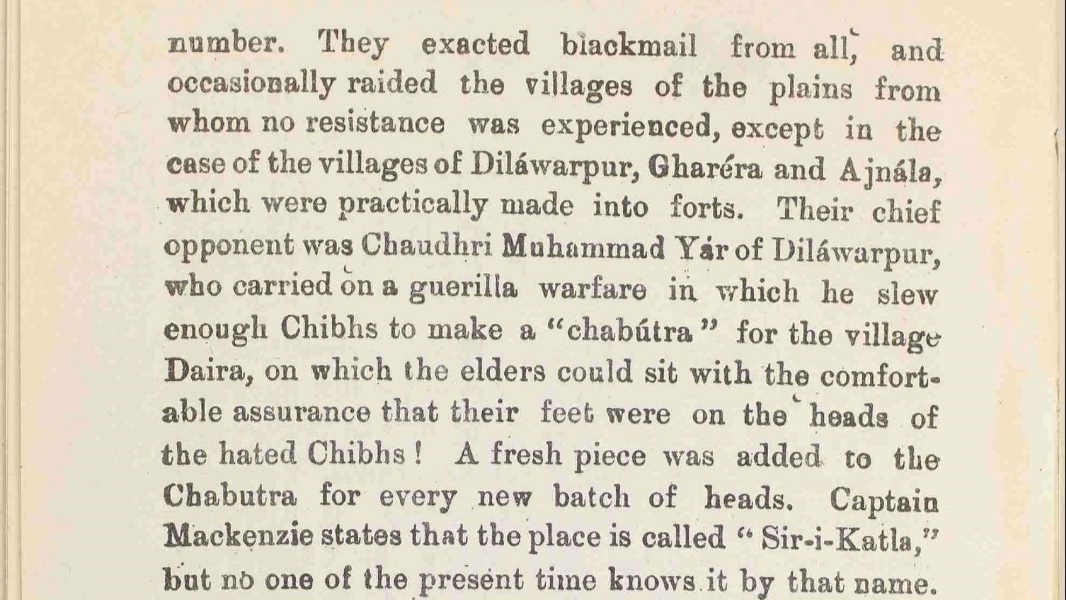
All to no purpose. With abundance of wood and stone at their doors, and all the advantages of a strong position with a submissive prey, it was not in the nature of things that a native government should stay their malpractices or reform their ways. From long exercise of their lawless strength, they acquired a prescriptive right to certain payments from some of the villages inhabited by Jats beneath them. It was however only a right of might and diminished in strength with remoteness of locality. Thus at the foot of the Hill feudatories called it maliki, further away it was styled mangni. Payments were "sub rosa" made of mangni by border villages to secure immunity against outrage. They exacted blackmail from all, and occasionally raided the villages of the plains from which no resistance was experienced, except in the case of the villages of Dilawarpur, Gharera, and Ajnala, which were practically made into forts.
Their chief opponent was Muhammad Yar, Chaudhri of Dilawarpur, which was the headquarters of Zail Handu. He belonged to the Gujjar tribe, which occupies a leading position amongst the zamindars in the Gujrat district. He was an inamkhwar and possessed considerable influence in the district. His prowess was sung by the bard of the clan. He was, however, but poorly supported by the government, and the results were shown in heads and scalps rather than in pacification and tranquillity. Muhammad Yar carried on a guerrilla warfare in which he slew enough Chibs to make a chabutra (terrace) for the village dera (rest-house) of their heads, on which his men sat in the evening when they smoked their hookahs with the comfortable assurance that their feet were on the heads of the hated Chibs. A fresh piece was added to the chabutra for every new batch of heads. Captain Mackenzie states that the place is called "Sir-i-Katla," but no one of the present time knows it by that name.
Midway there is a pool of water, where kafilas used to assemble and then to proceed together; otherwise travellers, especially the Sikhs, were plundered and killed by the neighbouring highway robbers: the road is now quite safe.
— Shahamat Ali (1847)
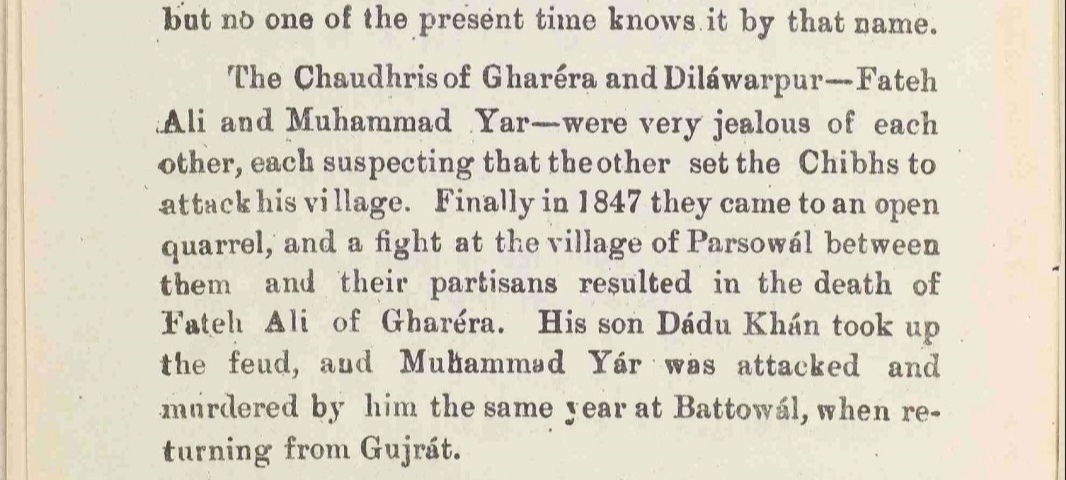
The Chaudhris of Gharera and Dilawarpur, Fateh Ali and Muhammad Yar, were very jealous of each other, each suspecting that the other set the Chibs to attack his village. Finally in 1847, they came to an open quarrel, and a fight at the village of Parsowal between them and their partisans resulted in the death of Fateh Ali of Gharera. His son Dadu Khan took up the feud, and Muhammad Yar was attacked and murdered by him the same year at Battowal, when returning from Gujrat.
Sources:
Suri, Sohan Lal, Umdat-ut-Tawarikh
Bute Shah, Ghulam Muhy-ud-Din, The geographical description of the Punjab
Ali, Shahamat, The Sikhs and Afghans
Wadhera, Ganesh Das, Char Bagh-i Panjab
Mackenzie, Captain Hector, Report on the revised settlement of the Goojerat district
Griffin, Sir Lepel H., Panjab Chiefs
Beg, Mirza M. Azam, Tarikh-i Gujrat
Gazetteer of the Gujrat District, 1883-84
Elliott, Alfred Charles, The chronicles of Gujrat
Wilson, Anne Campbell, Letters from India
Punjab past and present, volume 37